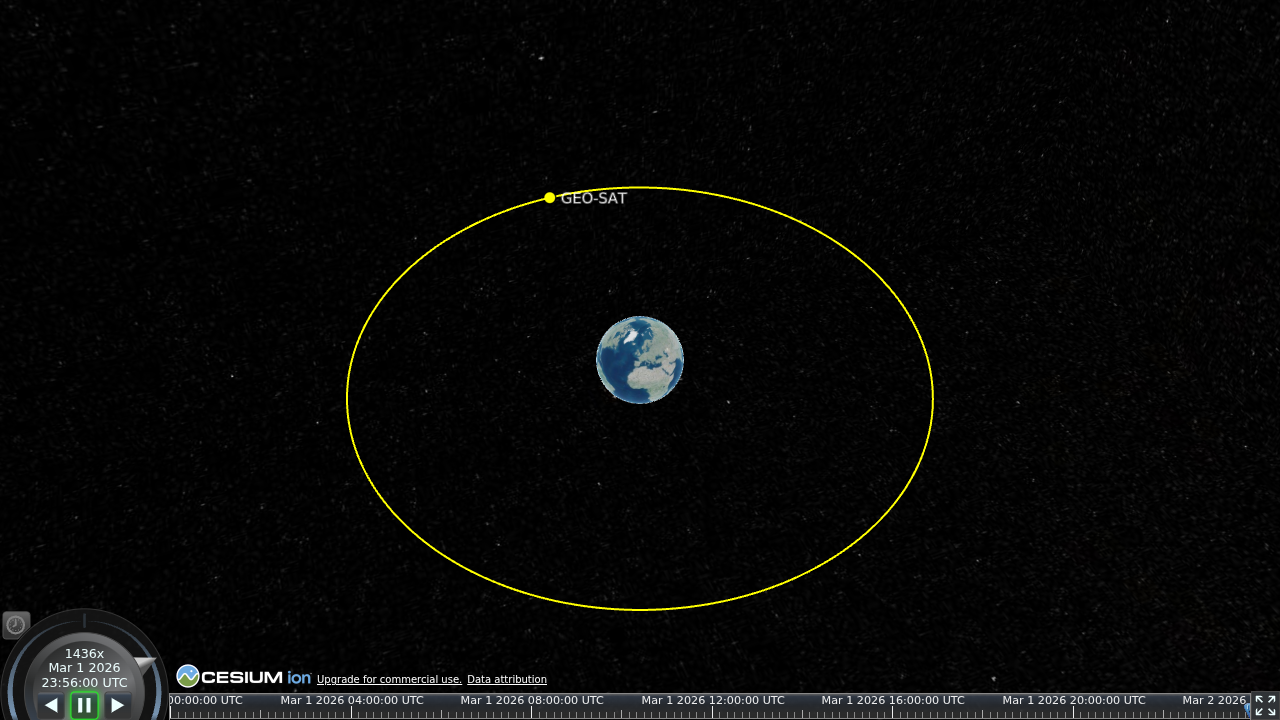
Orbit path
The core conversion: one validated trajectory becomes the CZML properties an entity packet carries — a sampled position, a path, a marker (a point or an image billboard), and a label — on a packet that also holds the object's identity and UTC availability.
What the converter does
Metres, not kilometres. CZML cartesian positions are metric; the canonical default is
kilometres. Every position is scaled to metres by the declared units.length (km or m). The
declared unit is authoritative — there is no unit guessing — and an unsupported unit is rejected.
Interpolation passthrough. The source's interpolation and interpolation_degree are carried
onto the CZML position as interpolationAlgorithm and interpolationDegree, so the client
reproduces the curve between sparse samples instead of chording straight lines. Source names map to
the CZML enum (LAGRANGE, HERMITE, LINEAR), case-insensitively. When the source declares no
interpolation, the orbit path defaults to Lagrange degree 5; an unrecognised algorithm is
rejected rather than guessed.
Compact, decimated samples. Epochs travel as a single reference epoch plus per-sample second
offsets, so the document carries one absolute timestamp rather than one per sample. The path is then
tolerance-bounded-decimated: an iterative cross-track Douglas–Peucker pass drops samples that
stay within ~1 km of the kept polyline, keeping the document small while preserving the geometry. A
degree + 1 floor guarantees enough support for the declared interpolation curve.
The reference frame is taken from the recognised frame id — inertial frames render in CZML
INERTIAL, Earth-fixed in FIXED (see the schema reference).
The properties
| Property | What it is |
|---|---|
position |
the sampled cartesian (metres), tagged with the interpolation hint and the reference frame |
path |
the orbit trail — a lead time of 0 and a trail spanning the whole trajectory by default |
point / billboard |
the object's marker glyph — a coloured dot by default, or an image billboard |
label |
the object's name, offset clear of the marker |
A multi-segment ephemeris is concatenated into one chronological sample series, so it renders as a single position property spanning the whole span. Multiple objects are handled one packet each — see the schema's multi-object note.
Styling
The marker, label, and orbit path are driven by the supplied Style — its
colour, width, pixel size, font, and glyph (a coloured point or an image billboard). The default is
sat-default; named presets and the customization API are covered in Styling.